
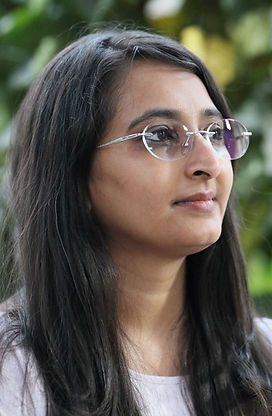
Krupa Rose
Founder & Principal Designer
Krupa's relationship with design began early, growing up around her father's work in construction and architecture. What started as an interest in buildings and spatial planning developed into a career spanning more than two decades across interior design, retail, hospitality and design education.
Her professional journey began in premium residential interiors, working alongside architects to create highly personalised homes. She later moved into retail and hospitality, designing and executing environments for international brands including GAP, Hamleys, Jockey and KFC. Working across such different environments taught her to look beyond aesthetics and understand how spaces need to function for the people who use them.
Krupa studied Interior Design at Jain College before pursuing a postgraduate programme in Retail Design at NICC - International College of Design & Technology. Her experience across practice and education has shaped a multidisciplinary approach to design, combining spatial thinking, technical understanding and a close observation of how people interact with their environments.
At Lemondust Studios, her approach begins with understanding rather than prescribing. She is particularly interested in the relationship between people, behavior and space: how movement, routines, habits and interactions influence the way an environment should be designed.
This also shapes the way she approaches existing spaces. Rather than assuming that everything needs to be replaced, she looks at what can be retained, adapted, repaired or reconsidered before introducing something new.
For Krupa, design is not simply about creating spaces that look good. It is about understanding what a space needs to do, and designing it to do that exceptionally well.

Dr. Akash
Mentor
A Foundation of Curiosity
The Studio's thinking was also profoundly shaped by the work and influence of Dr. Akash, whose multidisciplinary carer crossed science, product design, technology and industry.
His approach to problems was analytical without being confined by convention. He encouraged questioning, experimentation and looking at familiar problems from unfamiliar directions. He believed that seemingly unrelated disciplines could inform one another, and that the best solutions often emerged when a problem was examined from more than one perspective.
That spirit of curiosity, rigorous thinking and willingness to challenge the obvious continues to form a part of Lemondust's intellectual foundation.
Question the obvious. Understand the problem. Then design.