
What Is Design Actually Doing for You?

Updated: Sep 4
You probably don't think about design very often. You might think about it when you're renovating your home, choosing a sofa, selecting tiles, or scrolling through photographs of beautiful interiors online. But design has been affecting you long before you started thinking about whether your kitchen should be white or walnut. It affects where you put your keys when you come home. Where you leave your shoes. Where you sit when you want to work. Which route you take through your house every morning. Where everyone gathers when friends come over. How long it takes you to find something in a cupboard. Whether you switch on a light when you enter a room or spend the first few seconds feeling around for the switch. You may not call any of these things "design." But they are.
So perhaps the better question isn't "What does this space look like?"
What is this space actually doing for you?

Design Is More Than What You See
When we talk about design, we often talk about what is visible: color, furniture, materials, lighting, form. But these are only the things we can easily photograph. A space is also made up of relationships that are much harder to see: where people move, where they stop, what they reach for, what they avoid, what they do together, where they go when they want to be alone, where things are stored, and how one activity leads into another.
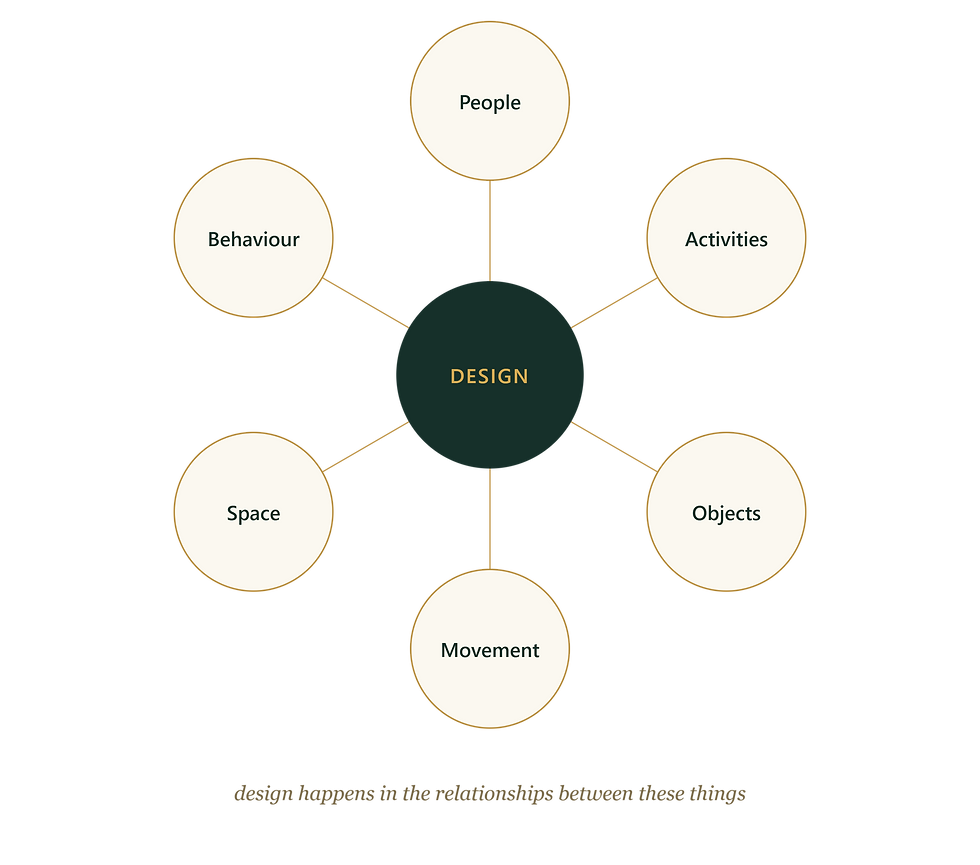
Design is therefore not simply the process of making a space look a certain way. It is the process of deciding how a space should work.
And once you start looking at it that way, ordinary spaces become much more interesting.
In this article
What design actually means
How design affects everyday life
Why good design removes friction
Why design isn't necessarily expensive
Why good design can mean buying less
What you're actually paying a designer for
What good design feels like when it works
Your Space is Quietly Influencing You
Every space gives you instructions. Not written instructions, obviously. There isn't a little sign on your dining table saying: Please deposit your handbag here. And yet, somehow, that's where it ends up. There isn't a sign saying: Stand here while you're talking to the person cooking. But somehow people gather around the kitchen counter. There isn't a rule saying: Work from the dining table even though you have a study. Yet plenty of people do exactly that. We respond to our surroundings constantly. We move towards convenience, avoid obstacles, choose comfortable places, follow familiar paths, put things where they are easiest to reach. We gravitate towards light, activity, warmth, privacy, or other people. Our surroundings don't merely contain our behavior. They participate in it. And that is where design becomes much more interesting than decoration.

Think About Your Morning
Imagine your ordinary morning. You wake up, reach for your phone, get out of bed, walk to the bathroom, brush your teeth, make coffee. Perhaps feed the dog, look for your keys before you leave the house. You've probably performed some version of this sequence hundreds or thousands of times. Now imagine that every step was slightly inconvenient. The bathroom door opens into the wrong space. Your clothes are stored on the other side of the bathroom. The coffee machine is far away from the cups. They don't have a place. The shoes are scattered around the entrance. The switch is behind the cupboard. Nothing is catastrophically wrong, but everything is just slightly annoying. Individually, each inconvenience seems trivial; together, they create friction. Now imagine the opposite. Everything is where you instinctively expect it to be. You don't have to think, you simply move.

Good design removes unnecessary friction from everyday life.
And very often, we don't notice it precisely because it works.
We Notice Design Most When It Fails
You rarely think about a door when it opens exactly as expected. But you'll remember the door that hits the cupboard every morning. You don't think about the location of a light switch when your hand finds it automatically. But you'll remember the switch hidden behind the wardrobe. You don't think about storage when the thing you need is exactly where you expect it to be. But you'll notice when you have to empty half the cupboard to find one saucepan. This is one of the strange things about good design. It can become invisible.
When something works effortlessly, it becomes part of the background of our lives. When something doesn't work, it keeps announcing itself.
A Beautiful Space Can Still Be Badly Designed
This is where our understanding of design often gets confused. We see a beautiful room and call it well-designed. And sometimes it is. But beauty alone doesn't tell us very much about how successfully a space has been designed. A room can have beautiful materials, expensive furniture, and perfect lighting and still be frustrating to live in. The sofa may block the natural path through the room. The kitchen may look wonderful but force you to walk back and forth constantly while cooking. The wardrobe may be enormous but poorly organized. The dining table may be beautifully positioned but become the permanent landing zone for everyone's bags, laptops, mail, and miscellaneous objects. The space photographs beautifully. But it isn't necessarily helping anyone. Design is not just about what you see. It is about what happens.

The Kitchen Is a Perfect Example
Take the humble kitchen. We often approach it as a collection of functions: storage, preparation, cooking, cleaning. But a kitchen is also a place where people gather. Someone is cooking. Someone is making coffee. Someone is talking. Someone is waiting for dinner. Someone is helping. Someone is simply standing there because that's where everyone else is. The kitchen becomes a social environment because of the activities taking place within it. This changes the design question. We're no longer asking only: Where should the cabinets go? We're asking: How should people be able to move, work, and interact here?
That is a much richer question.
Good Design Doesn't Always Mean More
There is another assumption worth questioning. Design does not always mean demolition. It does not always mean replacing everything. It doesn't necessarily mean a new kitchen, new furniture, new flooring, and a new color palette. Sometimes the best design decision is to keep something. Sometimes it is to repair it. Sometimes it is to move it. Sometimes it is to change one relationship rather than replace ten objects. And sometimes, of course, replacing something is exactly the right answer. The point is that design should begin with the understanding of what needs to change rather than assuming that everything needs to change.
This is also why good design can sometimes mean buying less. A problem that looks like a storage problem may actually be a circulation problem. A problem that looks like a furniture problem may actually be a layout problem. A problem that looks like a need for renovation may sometimes be a need for a better relationship between the things already there.
Design is not about adding more things to a room. It is about making better decisions about the things that belong in it.
What Happens When We Design Only for Appearance?
We end up designing for the photograph. The room looks beautiful when nobody is using it. The dining table has nothing on it. The kitchen counter is completely clear. The cushions are perfectly arranged. Everything looks wonderful. And then real life arrives. Someone puts down a handbag. Someone leaves a laptop on the table. Someone cooks. Someone brings home groceries. Someone has children. Someone has a dog. Someone works from home. Someone gets older. Someone's needs change. A space has to survive contact with life. That is the real test of design.
What Are You Actually Paying a Designer For?
This is perhaps the most important question. If design is not simply about making something beautiful, then what exactly is the designer doing? A good designer is not merely choosing colors and finishes. They are observing. Questioning. Connecting. Anticipating. Making decisions. And sometimes, importantly, stopping unnecessary decisions from being made. They are looking at relationships that are difficult to see when you're standing inside your own problem. Where should this go? What happens when someone opens this? Who uses this? What happens when two people use the space at the same time? What happens five years from now? What happens when the family changes? These questions may never appear in the final photograph. But they can determine whether the space works.

The drawing is only one part of the work. The thinking behind it is where much of the value lies.
Design Begins with Observation
Perhaps this is why one of the most useful things you can do before redesigning a space is surprisingly simple: Watch yourself using it. Don't start by looking at Pinterest. Don't start by choosing colors. Don't even start by deciding what needs to be replaced. Watch. Where do you naturally sit? Where do you put your phone? Where does clutter accumulate? Which light do you switch on most often? Which drawer do you open every day? Which cupboard annoys you? Which room do people naturally gravitate towards? Is there a space nobody uses? Is there something you constantly move because it is in the wrong place? What do you repeatedly reach for? What do you keep working around?

These tiny observations are clues. They tell you how you and your environment are interacting. And once you start noticing them, something rather fascinating happens. You begin to see that your space has been participating in your life all along.
So, What is Design Actually Doing for You?
It is making some things easier, some things harder. Some behaviors more likely and others less likely. It is directing movement without giving instructions, creating comfort without saying why, creating friction without announcing itself, encouraging interaction, creating privacy, or making room for routines. Helping you buy only what you need and making existing things more useful. Sometimes even changing the way you behave without you consciously realizing it. That is the quiet power of design.

And perhaps the next time you look at a beautiful room, instead of asking " Do I like how this looks?" ask a slightly more interesting question: "What is this space allowing people to do?" And then ask: "What is it making difficult?" Because somewhere between those two questions is where design really begins.
At Lemondust Studios, we believe design should not simply make a space look better.
It should make the experience of inhabiting that space better. Because ultimately, we don't live in photographs.
We live in spaces.
And those spaces become part of how we live.
Comments